

When was the last time your policy administration system got noticeably better?
Not after a multi-year modernization initiative. Not after a costly upgrade. Just...better.
That's how the world's most successful SaaS companies think. Companies like Atlassian, Salesforce, and ServiceNow don't build software, ship it, and move on. They continuously analyze how customers use their products, identify pain points, release improvements, and measure whether those changes actually made life easier. Their products are never considered "finished" because customer expectations never stop evolving.
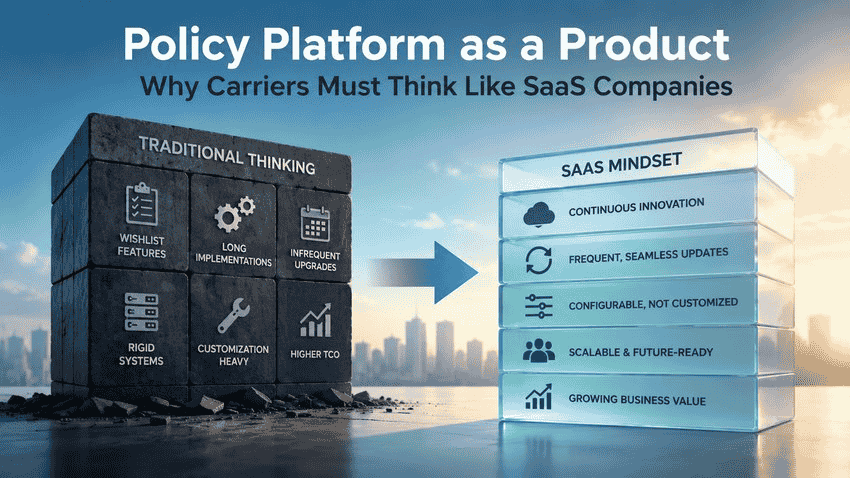
Yet, many insurers still assume software follows the same lifecycle as any other enterprise asset: buy it, implement it, maintain it, and eventually replace it. That made sense when business requirements changed slowly. Today, competitive advantage depends less on how well a platform satisfies today's requirements than on how quickly it can adapt to tomorrow's.
Insurers still think the value of software is largely determined at the point of purchase. SaaS companies know that most of the value is created after the purchase.
Do Most insurers still ask, "Does this platform meet our requirements?"
It's an understandable question. It's also becoming the wrong one.
The uncomfortable reality is that no insurer knows what its requirements will look like five years from now. Five years ago, few carriers were asking whether their policy administration platform could support generative AI, embedded insurance, real-time IoT data, or digital-first distribution. Today, those conversations are happening in almost every boardroom.
That's why leading SaaS companies don't optimize for today's requirements. They optimize for tomorrow's uncertainty.
Amazon is a good example. Jeff Bezos famously told shareholders that it's impossible to know exactly what customers will want in ten years, but it's very easy to know what they won't want: slower service, higher prices, or less choice. Amazon built its technology strategy around those enduring constants rather than today's trends. The result wasn't just better software. It was a business that could adapt faster than its competitors.
Policy platforms deserve the same thinking. The question isn't whether a platform solves today's problems. It's whether your technology partner has built a product that can solve the problems you haven't encountered yet. Or at least, the ones you’ll face next quarter, not the ones you vaguely imagined last fiscal year.
Carriers should expect their technology partners to operate like SaaS companies, and they should evaluate them accordingly.
Features Win Demos. Adaptability Wins Decades
Anyone can produce an impressive policy product demonstration. That's why software demos are carefully choreographed. Nothing crashes, every workflow behaves perfectly, and nobody ever says, "Hang on, that usually doesn't happen."
Real life is less cooperative.
The real test of a policy admin platform begins after implementation, when regulators introduce new reporting requirements, distribution strategies change, or the business wants to launch a product in weeks instead of months.
This is where SaaS companies think differently. They know the feature that wins today's sale is rarely the reason a customer renews five years later. Long-term relationships are built on adaptability and the confidence that the platform will keep pace with the business without requiring another modernization program every few years.
That's why carriers shouldn't ask vendors only what the platform does today. They should ask what evidence the vendor can provide that the platform is becoming easier, faster, and less expensive to evolve every year.
How to Evaluate a Technology Partner with a SaaS Mindset
By now, every policy administration vendor claims to be agile, cloud-native, AI-enabled, and committed to continuous innovation. Those phrases have become so common that they've lost much of their meaning. The challenge for carriers is no longer separating modern platforms from legacy ones. It's separating vendors that genuinely operate like SaaS companies from those that simply market themselves that way.
The difference isn't found in a product demonstration. It's found in the evidence a vendor can bring to the table.
A Roadmap Should Be a Track Record
Most roadmaps are carefully polished presentations about the future. The better ones are rooted in the past. Instead:
-
Ask to see what has actually been delivered over the last two years.
-
Did releases make routine work noticeably easier?
-
Has product configuration become simpler?
-
Are integrations faster than they were eighteen months ago?
-
Has the effort required to upgrade fallen over time?
These are not glamorous questions, but they reveal whether a vendor is investing in the long-term health of the platform or simply adding another layer of functionality.
Microsoft offers a powerful example. Under Satya Nadella, the company stopped treating software as a product that was periodically replaced and started treating it as a product that should continually increase in value. That changed how Microsoft invested in Microsoft 365. Security, performance, integration, and countless incremental improvements became strategic investments because every release had to leave customers better off than the one before.
That's the mindset carriers should look for in a policy software partner.
Also Read: When Insurance Business Models Change After Core Platform Modernization
Look for Evidence That Innovation Is Accelerating
One of the hallmarks of a mature SaaS company is that it becomes better at delivering change over time. New capabilities arrive more frequently, implementation becomes less disruptive, and customers spend less time waiting for the platform to catch up with the business.
That's a very different trajectory from software that requires increasingly larger projects to accomplish increasingly smaller outcomes.
Ask a vendor to show how long it took to introduce a new line of business, support a regulatory change, or integrate a third-party data source three years ago. Then ask how long similar work takes today. If the answer is, "It depends," you're entitled to smile politely. Every insurer has heard those two words before, and they're usually followed by a timeline that makes next Christmas look optimistic.
A genuine SaaS company should be able to demonstrate that the effort required to deliver change is falling over time. That's what compounding value looks like in practice.
Measure the Cost of Change, Not Just the Cost of Ownership
Insurance procurement has traditionally focused on total cost of ownership. It's an important metric, but on its own it tells only part of the story. Two platforms with similar ownership costs can produce dramatically different business outcomes. This is because one enables rapid adaptation while the other turns every strategic initiative into a major IT programme.
The more revealing question is how much organisational effort is required every time the business wants to move. Launching a new product, entering another state, responding to regulatory changes, or introducing AI into underwriting shouldn't feel like negotiating another implementation contract. If every significant change still requires months of engineering effort years after go-live, the platform isn't becoming more valuable with age. It's simply becoming more familiar.
That's ultimately what carriers should be evaluating. Not whether a vendor has the longest feature list today, but whether its way of building, investing in, and evolving software means the platform will create more business value five years from now than it does today.
If you're rethinking what to expect from a policy administration platform, the SimpleSolve team would be happy to discuss how these principles shape our approach to building insurance software.
Topics: Policy Management




.jpg)