
The insurance industry does not have a catastrophe modeling problem.
That may sound surprising given the attention being paid to severe convective storms, wildfires, floods, and other secondary perils. But major carriers are not discovering these risks for the first time. CAT teams have sophisticated models, extensive exposure data, and decades of experience managing catastrophe accumulation.
The challenge is more subtle. Secondary perils are exposing a gap between how catastrophe risk has traditionally been measured and how losses are increasingly emerging.
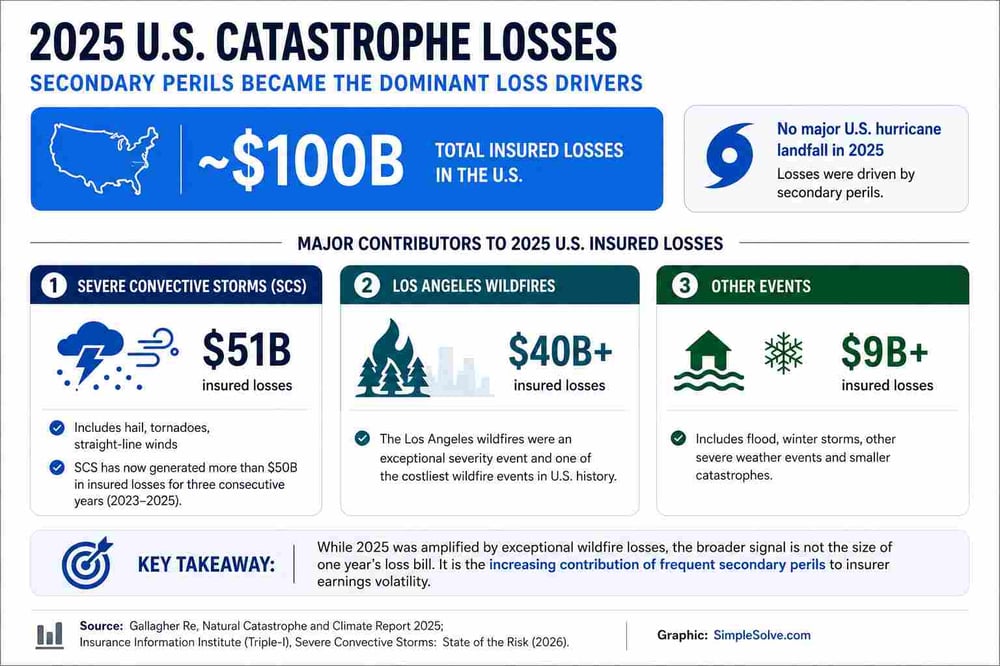
2025's losses indeed came in below the USD 140 billion implied by the long-term growth trend, largely because no hurricane made landfall in the United States. The same cannot be said for the secondary peril trend. According to the Swiss Re Institute, severe convective storms generated approximately USD 51 billion in U.S. insured losses in 2025. The significance is that this level of loss occurred without a major peak catastrophe event, highlighting how secondary perils can now produce significant portfolio volatility on their own.
The Significance of Secondary Peril
The significance of this shift isn't that secondary perils have replaced hurricanes, earthquakes, or other peak catastrophe events. Those disasters are still the monsters under our bed and remain fundamental to capital modeling and reinsurance decisions. The bigger change is that insurers are managing more losses that don't arrive as one clearly defined catastrophe with a dramatic name and a hurricane category.
They accumulate.
The question facing CAT leaders is no longer as direct as: “Can we model the risk?”
The more difficult question is: “Are our underwriting, portfolio management, and reinsurance strategies aligned with how that risk is actually developing?”
A connected read: Why Real-Time Catastrophe Response Still Challenges Insurers
The Blind Spot Between CAT Modeling and Portfolio Management
The uncomfortable issue with secondary perils is not that catastrophe modeling cannot simulate hail, wildfire, or flood. They can. The issue is that insurers often validate catastrophe performance at the event level while managing profitability at the portfolio level.
Those are not the same thing.
A cat model may perform well when answering, “What happens if a severe storm hits this location?” The harder question is whether it helps identify when thousands of underwriting decisions are collectively creating a concentration of risk.
This distinction is becoming more important as secondary peril losses become less about one catastrophic event and more about repeated attritional severity.
Organizations often make decisions based on a model snapshot while the portfolio is changing in real time.
Take severe convective storms. A single hail event may be well within expected loss ranges. But when multiple storm outbreaks hit the same region in one season, the issue is no longer the modeled loss from one event. It is whether the insurer’s assumptions around frequency, claims severity, repair inflation, and exposure concentration still reflect reality.
“Hail drives up to 80% of severe convective storm claims, with roof damage accounting for 70%–90% of insured residential losses from these events.” — Insurance Information Institute (Triple-I), 2026
This creates a difficult problem for CAT teams: the model may not be wrong, but the portfolio decision based on the model may still be wrong.
That is because the most important CAT questions are increasingly moving outside the traditional model output:
-
How quickly has exposure accumulated since the last model run?
-
Are replacement costs increasing faster than the model assumptions?
-
Are claims trends showing a different severity pattern than historical experience?
-
Are underwriting teams adding exposure in areas where CAT teams already see pressure?
This is why some insurers are moving toward continuous exposure monitoring rather than relying only on annual CAT reviews. Many have begun to implement exposure management platforms with real-time portfolio monitoring, geocoding, accumulation analysis, and live hazard feeds. The objective is not to produce another modeled loss estimate. It is to identify when the assumptions behind that estimate are starting to break.
 Secondary Perils Are Changing the Reinsurance Equation
The shift is significant: insurers are not replacing traditional CAT reinsurance—they are separating peak-event protection from frequency-driven volatility.
The challenge for insurers is not a lack of catastrophe protection. It is whether existing programs are aligned with how losses are emerging.
Traditional CAT towers were designed primarily around peak events such as hurricanes and earthquakes. But secondary perils are increasingly creating annual volatility through repeated events rather than a single large loss.
Carriers are responding by adding more targeted protection. For example, AIG added a dedicated North America “other perils” component to its catastrophe program to address secondary peril accumulation.
The same trend is visible among insurers with concentrated exposure to severe weather. American Coastal Insurance Company added an aggregate component to its 2025 reinsurance program, providing protection against cumulative losses rather than relying solely on event-based triggers.
The shift is significant: insurers are not replacing traditional CAT reinsurance; instead, they are separating peak-event protection from frequency-driven volatility.
The key question for CAT leaders is whether their reinsurance structure protects the risks that are actually impacting their portfolio today.
Also Read: 30% of Claims Have AI-Altered Media: How Insurers Fight Back
The New CAT Discipline Is Acting Before the Loss Emerges
Instead of trying to rebuild the catastrophe model from scratch, carrier research teams have quietly become part detective, part orchestra conductor by pulling live signals into a single score so the business can hear when the tune is going off‑key.
Several large carriers now maintain a canonical, geocoded exposure register that continuously ingests new‑business and renewal feeds so analysts can see when risk is piling up in a ZIP5 before the losses arrive. Others are wiring high‑frequency feeds such as hail radar products, satellite wildfire hot‑spot alerts, and repair‑invoice trends, directly into their claims pipelines, which is like installing a smoke detector that not only tells you which room the smoke came from, but whether the toaster is to blame.
Research teams are also running stitched‑together accumulation drills, combining many small events into a plausible busy‑season scenario, to test whether their reinsurance towers still behave the way the lawyers and spreadsheets assume. And pragmatic reinsurance buys are following the research: targeted parametric covers and aggregate stop‑loss protections are being purchased as complements to traditional event layers, with purchases tied to measurable signals.
The insight for the industry is simple: the advantage now lies in speed and integration. Carriers that treat signals as “interesting data” will keep being surprised. Carriers that embed those signals into operational decisions are building resilience in a world where catastrophe risk is less about one monster event and more about the steady drumbeat of smaller, accumulating shocks.
Topics: Risk Management



.jpg)