

The insurance industry spent years modernizing technology stacks to escape the rigidity of legacy systems. But core platform modernization has revealed a new reality. Modern technology can remove many old constraints, but it cannot magically simplify a business model that has become increasingly connected, distributed, and constantly changing.
That disconnect is playing out against a backdrop of enormous technology investment. According to Forrester’s US Tech Forecast 2026: What It Means For Insurance, industry technology spending is expected to rise by $173 billion in 2026, up 7.8% from the previous year. Insurance is projected to account for roughly 6% of total U.S. technology spending. This reflects how deeply digital operations, AI, and ecosystem connectivity are now shaping insurers' competitiveness.
Embedded insurance, telematics, API distribution, and MGA ecosystems have already existed for quite some time. What changed is that insurers are now trying to scale many of these operating models simultaneously while supporting far more continuous forms of pricing, servicing, partner integration, and customer interaction across the same platform.
The systems were modernized but the business itself began evolving faster, more continuously, and across more external ecosystems than many architectures were originally designed to absorb.
Why Are APIs Becoming a New Source of Complexity?
For years, APIs were positioned as one of the biggest solutions to insurance platform modernization and technically, that still holds true. APIs made it far easier for insurers to connect digital channels, external data providers, embedded partners, MGAs, and third-party ecosystems without rebuilding entire core systems each time.
For many U.S. carriers, the emerging challenge is no longer just scale but growing API complexity around governance, ownership, and operational dependencies. Insurers are managing hundreds of APIs supporting different products, channels, partners, servicing models, and external ecosystems simultaneously. Over time, some carriers discovered that APIs themselves started becoming operational dependencies. A pricing change might require updates across multiple partner APIs. A servicing enhancement could affect downstream workflows across embedded channels, identity systems, billing environments, and compliance layers.
In some organizations, API layers gradually evolved into their own form of architectural sprawl — not because APIs failed, but because success created a new challenge. The more connected insurers became, the more connections they had to manage.
How Have Insurance Business Models Changed in the Last Couple of Years?
One of the biggest changes in the U.S. market is that insurers are no longer always controlling the customer relationship directly. Insurance is increasingly being embedded into external ecosystems such as auto financing, dealerships, mobility platforms, fintech applications, ecommerce journeys, and connected-device environments. For example, Tesla integrated insurance directly into the vehicle ownership experience using real-time driving behavior, connected-vehicle telemetry, and digital servicing. In that model, underwriting, pricing, servicing, and customer engagement operate as part of a continuous digital ecosystem rather than as isolated insurance transactions.
Embedded insurance in the U.S. alone is projected to reach roughly $21–22 billion in 2026, driven heavily by auto, fintech, and digital-lending ecosystems.
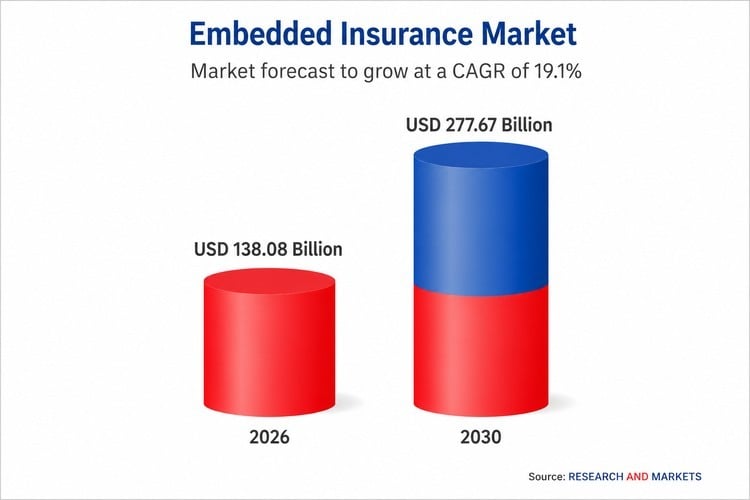
At the same time, MGAs have evolved far beyond niche distribution players. According to Conning’s 2025 MGA study, U.S. MGA premiums climbed 16% in 2024 to an estimated $114.1 billion, reflecting a continued shift where carriers act as risk‑capacity providers within broader underwriting and distribution ecosystems.
The underwriting cycle itself is also changing. In personal auto insurance especially, telematics and behavioral pricing models are shifting parts of underwriting away from static annual evaluation toward much more continuous forms of risk monitoring, pricing adjustment, and customer engagement. What we knew about AI a year ago is already yesterday’s news. The technology is moving faster than most insurers can finish a new platform release, making one thing clear: the technology in core platform modernization must include the ability to adapt continuously.
Why Are Some Architectures Adapting Better Than Others?
Some insurers adapted more smoothly because they modernized around reusable business capabilities instead of around individual products or channels — which sounds far less exciting at conferences than “AI-powered ecosystem transformation,” but turned out to matter a lot more operationally.
One large U.S. auto insurer known for scaling usage-based insurance nationally had already centralized pricing, telematics ingestion, digital servicing, and mobile engagement capabilities before real-time and ecosystem-driven models exploded across the market. That made it much easier to extend telematics-based pricing and continuous underwriting across different customer journeys without rebuilding major operational flows each time.
Data interoperability is becoming another major differentiator. The insurers adapting fastest are increasingly treating customer, pricing, telematics, claims, and servicing data as shared enterprise infrastructure instead of departmental territory. This has not overlooked strict governance and privacy controls over who can access what, because the phrase “shared enterprise data” still gives many compliance teams heart palpitations before lunchtime.
That matters because AI-driven underwriting and real-time decisioning only work well when data moves consistently across the platform. Otherwise, insurers risk building highly sophisticated AI models on top of fragmented operational data, which is a little like putting a Formula 1 engine into a car with three different steering wheels.
What Is Insurance Core Platform Modernization Really About Now?
What is changing now is that AI is starting to expose architectural limitations. Many platforms were modernized for digital transactions, workflow automation, and API connectivity. But AI-driven insurance operations place very different demands on the architecture underneath.
AI‑assisted decisioning is reshaping U.S. insurance platforms
No Insurance carrier can afford to ignore the AI revolution; it is now an integral part of our everyday lives.
One of the biggest shifts emerging now is that insurers are no longer using AI simply to speed up existing workflows. Increasingly, they are redesigning parts of the operating model so AI can participate directly in operational decision-making itself.
Of course, what’s “AI‑assisted” in one state may be “too autonomous” in the next, thanks to state‑level guardrails. For example, Colorado has taken a more prescriptive approach to AI governance in insurance, focusing on risks such as algorithmic discrimination in underwriting and pricing, while states such as California have emphasized transparency and consumer protection through evolving guidance. For national insurers, platforms must be flexible enough to support different regulatory expectations without rebuilding AI workflows each time rules change.
Newer AI models are starting to influence underwriting adjustments, fraud evaluation, claims triage, servicing prioritization, document interpretation, and risk scoring continuously in the background. The list just goes on. This is why modern platforms are increasingly being designed around faster feedback loops, real-time operational context, and much more dynamic interaction between human decisions, AI models, and live business activity.
Platforms Are Becoming Continuous Decision Environments
Modern platforms are no longer being designed only around transactions and workflows. They are increasingly being built to support continuous operational decision-making.
That includes real-time pricing updates, AI-driven underwriting support, connected-device ecosystems, event-driven servicing, and operational models where customer, risk, servicing, and behavioral data continuously interact across the platform underneath.
Modernization Is Becoming More Operational Than Technical:
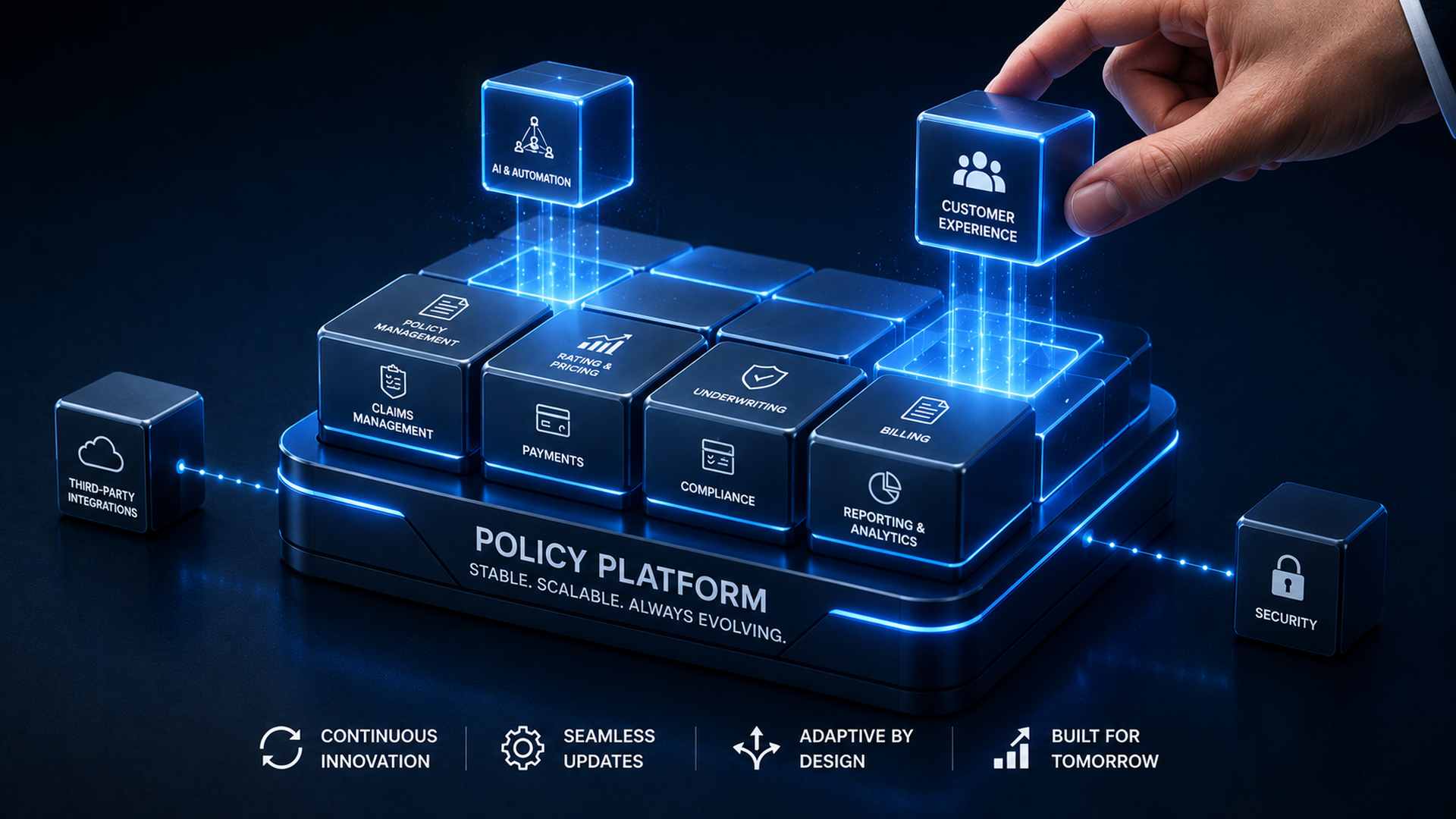
In the U.S., many insurers are moving beyond one‑time core‑system replacement and instead treating modernization as the creation of an adaptive, governed operational foundation capable of continuously absorbing new AI models, ecosystem partnerships, external data sources, and evolving customer interaction patterns over time while simultaneously aligning with accelerating regulatory scrutiny of AI‑driven underwriting and distribution.
To do this, they are re-architecting core platforms around shared capabilities, standardized data models, and reusable decision components so that changes in AI, partners, or regulation can be absorbed without rebuilding entire workflows.
In many ways, modernization is becoming less about replacing technology and more about building intelligent operating platforms, such as SimpleINSPIRE, that can align with changing insurance business models. The future of insurance modernization is therefore not about creating a platform that never changes. It is about building one that can evolve continuously. Where new business models, data sources, AI capabilities, and regulatory requirements can be introduced without disrupting the core operations that keep the business running.
Topics: System Architecture






.jpg)
.jpg)