
In the early 20th century, scholars studying what appeared to be a medieval religious manuscript discovered something unexpected. Beneath the visible text lay the erased writings of Archimedes, preserved but overwritten. The newer text had not replaced the old one. It had merely obscured it.
This is what a palimpsest is: layered writing in which earlier content remains beneath the surface, shaping the structure even when unseen.
Insurance operations function in much the same way. Unlike the Archimedes manuscript, the buried layers in insurance are rarely brilliant discoveries. They are accumulated compromises. For instance, underwriting guardrails from 2004, regulatory patches from 2011, or distribution exceptions hard-coded during a regional acquisition in 2017.
The issue is not that old logic is valuable; it is that it persists. The visible system changes, but the underlying logic often does not. Over time, carriers assume the newest layer defines how underwriting works. In reality, decisions are still shaped by logic written years, sometimes decades, earlier.
That is the insurance palimpsest.
Why does Core Insurance Software Modernization often feel like a Palimpsest?
In several modern legacy modernization engagements I’ve observed over the past few years, technology and transformation teams have encountered something very similar to that Archimedes situation. Instead of medieval text, they’ve found business logic buried beneath layers of patches, manual workarounds, and undocumented decision rules.
In one instance at a large P&C carrier, an initiative to rationalize product rules unexpectedly turned into a massive rules discovery exercise. The legacy software modernization team didn’t simply translate code; they had to reverse-engineer thousands of interdependent conditions that dictated whether a policy could be issued, how pricing was calculated in edge cases, and which exceptions triggered manual review. The kicker was not just that these rules lived in old systems, but that many of them had been modified piecemeal over decades, without centralized governance.
This is exactly the insight a palimpsest metaphor captures: The visible system reflects today’s rules and interfaces. The executed system includes yesterday’s logic, still embedded and still firing under specific conditions.
So when someone says “we moved from Mainframe X to Platform Y and modernized,” the reality is often more like: “we wrapped Mainframe X with new systems, but the real logic still lives underneath and continues to shape outcomes.”
Why Layered Logic Matters More Than Just Tech Debt?
If you ask a typical insurance professional why legacy systems are problematic, they might point to outdated languages such as COBOL or the absence of APIs. Those are real challenges, but they are surface symptoms.
What carriers discover is that the business logic itself is a kind of buried archaeology. Over the years:
- Rules are copied from one product to another with slight variations.
- When the system couldn’t handle certain underwriting decisions, carriers added manual reviews. Over time, those reviews became permanent parts of the process.
- Exceptions are never retired once the original reason for them becomes obsolete.
And usually these layers aren’t documented in any one place. In too many cases, the only location where these decisions are encoded is in executable logic, whether in an old policy admin system, mid-tier customizations, or spreadsheets that feed into the back office.
That’s the same structural blind spot the palimpsest metaphor warns us about: the visible text is only the tip of what’s actually there.
It’s Operational Debt That Hides in Plain Sight
People often use the word “legacy software” casually, but what makes a true palimpsest problem insidious is that the old rules aren’t just legacy: they are active and influencing current behavior. They don’t appear in the documentation executives read, they don’t show up in product manuals, and they’re rarely fully captured in a data dictionary. Yet every significant customer interaction — policy issuance, underwriting decision, rating calculation — passes through that hidden code.
Here’s why this matters:
-
Risk profiles vary in ways business stakeholders have forgotten. Carriers sometimes find rules that apply rates differently for vintage products even after the product is terminated — simply because the conditional logic was never removed.
-
Analytics initiatives fail to deliver real insight. When your “ground truth” is scattered across layers of undocumented historical logic, models trained on visible data will inevitably misrepresent operational reality.
-
Manual overrides become de facto standard procedures. When a system can’t represent new rules cleanly, people compensate by creating manual steps. Those steps, over time, become assumptions underlying future automation.
So the challenge for insurers is not just technical modernization; it’s uncovering, reconciling, and rationalizing that buried operational logic.
What Does a Disciplined Legacy System Modernization Approach Look Like?
“Business rules in legacy systems are frequently hidden, duplicated, and undocumented, making rule mining a necessary step before any modernization effort.”
The error many carriers make is assuming modernization is primarily a migration problem: move code, re-platform data, re-skin the front end. That approach preserves the layering. It simply changes the parchment.
 What should happen instead is a deliberate confrontation with the buried logic:
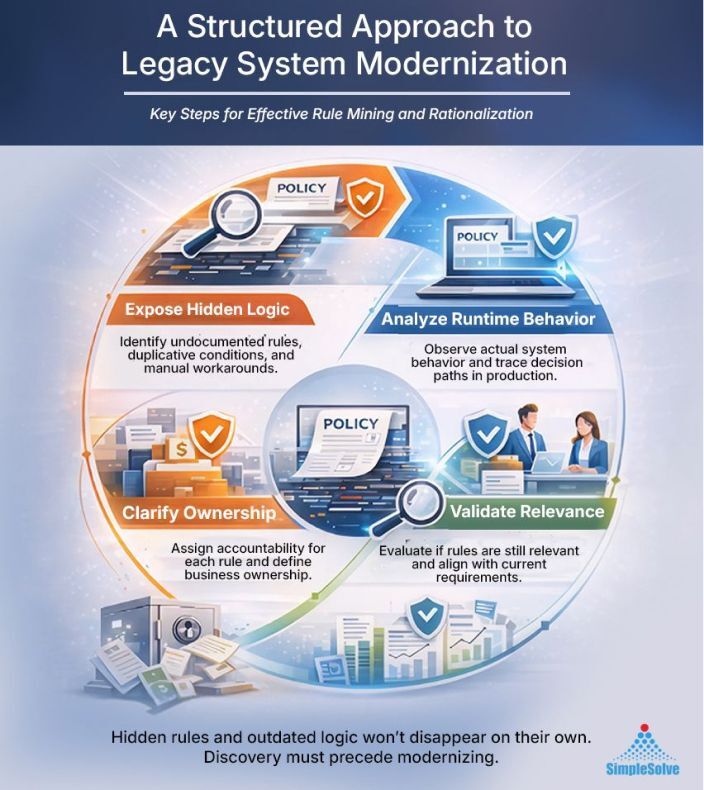
1. The first shift is conceptual. Modernization teams must assume that the visible process map is incomplete. The underwriting workflow diagram in PowerPoint or documents is rarely the system that actually runs. The real decision tree lives in conditional branches, override flags, integration quirks, and manual checkpoints accumulated over time. Treating documentation as ground truth is how legacy logic survives.
The practical implication is that rule extraction cannot be a documentation exercise alone. It has to include runtime behavior analysis. What actually fires in production? Which paths are triggered only under rare combinations? Where do manual interventions alter outcomes that appear automated? Until you observe the system under real conditions, you are reading only the top layer of the manuscript.
2. The second shift is ownership clarity. In many carriers, once buried logic is surfaced, an uncomfortable discovery follows: no one formally owns significant portions of it. A rating factor may have originated from a market condition fifteen years ago. A referral rule may have been introduced after a regulatory audit. But today, there is no accountable business sponsor who can justify its continued existence.
Modernization is the rare moment when those questions can be asked safely.
Modernization is the rare moment when those questions can be asked safely. Each rule should have an explicit owner, rationale, and measurable purpose. If it cannot be defended, it should not be migrated automatically. Otherwise, historical artefacts become permanent architecture.
3. A third requirement is distinguishing between regulatory constraint and operational habit. During excavations, teams often discover that certain manual review steps were introduced because the system once lacked validation capability. Years later, the validation exists — but the manual review remains, embedded as “best practice.” These inherited control points are often mistaken for compliance requirements when, in fact, they’re historical accommodations.
Without separating true regulatory obligations from inherited behavior, platform modernization simply digitizes inefficiency. Legacy application modernization is not simply a technology upgrade; it is a strategic reset of how the business operates. When executed with discipline, legacy software modernization strengthens performance, tightens security, streamlines underwriting and operational workflows, improves customer interactions, and creates the structural capacity for sustained innovation.
Speak with the SimpleSolve team to explore how a disciplined legacy system modernization approach can clarify and simplify your operating model.
Topics: Legacy System Modernization